Lesson 2 of 126
The lesson
1.2 Writing Systems: Kana
Overview
Learn the two Japanese syllabaries: hiragana and katakana. This lesson explains how each character represents a sound and covers the full hiragana and katakana tables, including modified and combination characters.
Kana
You know the theory? Practice kana with our quiz:
Practice kanaKana is a general term for both of the Japanese syllabaries: hiragana and katakana. These two are used alongside with kanji for writing in Japanese. Each of these three alphabets has a specific use-case.
Hiragana (ひらがな平仮名) is used for simple Japanese words or words whose kanji is too hard. Or in certain cases and especially in texts intended for kids, it is used for furigana (transcription of words written in kanji that is usually floating above these words directly in texts). However, most importantly it is used for writing grammatical constructions such as conjugation of verbs or particles.
Katakana (かたかな片仮名) is seen less often then hiragana. Most prominently it is used for writing loan words. Sometimes katakana could also mean emphasis. Furthermore, some dictionaries (not excluding ours) use it for listing the onyomi (Chinese readings) of kanji.
Kanji (かんじ漢字) is the third set of characters, which is used for writing words. Unlike kana characters, each kanji has its own meaning and expresses a specific concept. Nonetheless, there is an abundant amount of these which makes it quite difficult to master kanji.
Additionally, you can also come across the term romaji, which is basically the transliteration of kana to the latin script.
Learning kana
The best thing to do in the beginning of the Japanese language learning journey is to learn kana. More particularly, starting with hiragana and continuing with katakana.
Hiragana
Words in Japanese consist of sounds also referred to as morae (in plural) or mora (in singular). This is a linguistic concept similar to syllable. A mora is a basic timing unit in the spoken Japanese language. Each mora is either a vowel (such as あ) or a pair of a consonant and a vowel (such as か), with one exception being ん ( n') consisting of only one consonant.
Each hiragana character represents a single mora. Some characters can be modified by dakuten ゛ or handakuten ゜. Additionally, some morae are represented by a combination of two hiragana characters, where the second one is smaller in size (e.g. きょ / kyo compared to きよ / kiyo). And then there is also the special small tsu character. A closer explanation for all of this awaits you in the following paragraphs.
I would like to start with explaining how to read each of the characters. In the hiragana table below, you can see each character placed in the consonant - vowel grid. Except for a few exceptions, the characters in the columns share the initial consonant and the characters in each row share the final vowel. Now I will explain each character starting from the upper right corner going column by column to the left.
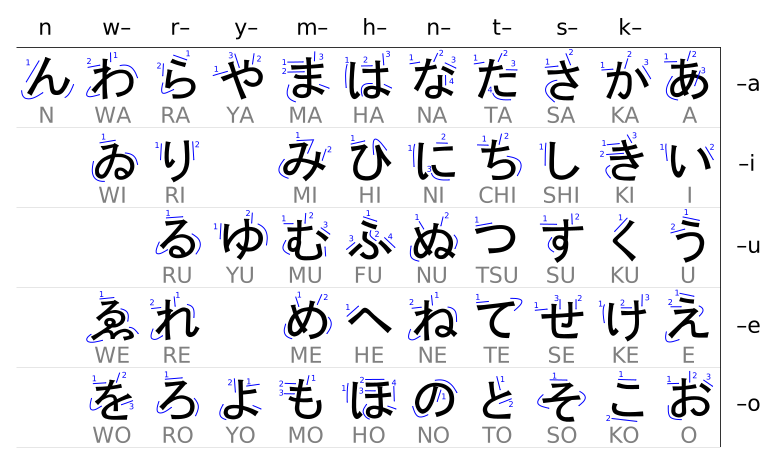
The A series
Each of the characters in this columns represents a single vowel.
| Kana | Romaji | Reading |
|---|---|---|
| あ | a | u in duck (dUHk) |
| い | i | i in dig |
| う | u | u in put |
| え | e | e in let |
| お | o | o in rock (rAHk) |
The K series
There are no exceptions here. Each of the characters is read as c in cut plus the corresponding vowel from the A series.
| Kana | Romaji | Reading |
|---|---|---|
| か | ka | cu in cup (cUHp) |
| き | ki | ki in kitty |
| く | ku | cou in could |
| け | ke | ke in kettle (kEt-l) |
| こ | ko | co in conversation |
The S series
These characters are read as s in sell concatenated with the respective vowel from the A column. There is one exception though, し / shi is read as shi in ship.
| Kana | Romaji | Reading |
|---|---|---|
| さ | sa | su in sun |
| し | shi | shi in ship |
| す | su | sou in soup |
| せ | se | ce in center |
| そ | so | so in sock |
The T series
These characters are read as t in tall followed by the respective vowel from the A column. There are, however, two exceptions. These are ち / chi and つ / tsu.
| Kana | Romaji | Reading |
|---|---|---|
| た | ta | tu in tuck |
| ち | chi | chi in chicken |
| つ | tsu | tsu in tsunami |
| て | te | te in tell |
| と | to | to in top |
The N series
These characters are read as n in neck followed by the respective vowel from the A column. Lucky you, there are no exceptions here.
| Kana | Romaji | Reading |
|---|---|---|
| な | na | nu in nut |
| に | ni | ni in nit |
| ぬ | nu | noo in nook |
| ね | ne | ne in neck |
| の | no | no in knock |
The H series
These characters are read as h in house followed by the respective vowel from the A column. There is one exception though, ふ / fu is read as something between F and H followed by う. It would be like something between foo in food and hoo in hood.
| Kana | Romaji | Reading |
|---|---|---|
| は | ha | hu in hut |
| ひ | hi | hi in hit |
| ふ | fu | between foo in food and hoo in hood |
| へ | he | he in hetero |
| ほ | ho | ho in hot |
The M series
These characters are read as m in mouse followed by the respective vowel from the A column. Fortunately, no exceptions here.
| Kana | Romaji | Reading |
|---|---|---|
| ま | ma | mu in mum |
| み | mi | mi in mist |
| む | mu | mu in mood |
| め | me | me in melon |
| も | mo | mo in modify |
The Y series
These characters are read as y in you followed by the vowel from the A column. Note that there are no yi and ye sounds in Japanese.
| Kana | Romaji | Reading |
|---|---|---|
| や | ya | yu in yucky |
| --- | yi | --- |
| ゆ | yu | you (in you) |
| --- | ye | --- |
| よ | yo | y'a in y'all |
The R series
This one is a bit tricky pronunciation-wise. The characters in this column are pronounced as something between R and L followed by the vowels from the A column. To better understand how to pronounce the R / L sound, you can refer to this article on Tofugu.
| Kana | Romaji | Reading |
|---|---|---|
| ら | ra | combination of ru in run and lu in luck |
| り | ri | combination of ri in rick and li in lick |
| る | ru | combination of roo in root and loo in loot |
| れ | re | combination of re in rest and le in let |
| ろ | ro | combination of ro in rock and lo in lot |
The W series
In the chart shown above you can see four characters. Nonetheless, ゐ / wi and ゑ / we are not used in modern Japanese (for more info you can refer to this article). That leaves us with わ / wa and を / wo.
を / wo is ever only used as an object marking particle, and it is pronounced as o in lock.
わ / wa, on the other hand is normally used in words. It is pronounced as wa in wasabi.
| Kana | Romaji | Reading |
|---|---|---|
| わ | wa | wa in wasabi |
| ゐ | wi | --- |
| --- | wu | --- |
| ゑ | we | --- |
| を | wo | o in lock |
The lonely ん / n character
As already mentioned, ん / n is the only kana character consisting of only a consonant. It is pronounced as n in hen. To type it, you need to type two consecutive n-s (nn) - especially if it is followed by a consonant, y or nothing at all.
| Kana | Romaji | Reading |
|---|---|---|
| ん | n | n in hen |
Dakuten ゛ and handakuten ゜
Characters in some series can be modified by dakuten ゛ and handakuten ゜. These diacritics modify the sound of the consonant in the character in a specific way. The vowel, however, stays unchanged.
Dakuten ゛ can be applied to the K, S, T and H series. Handakuten ゜ can only be applied to the H series.
The K series with dakuten ゛
The k sound changes into g as in good.
| Kana | Romaji | Reading |
|---|---|---|
| が | ga | gu in gut |
| ぎ | gi | gui in guitar |
| ぐ | gu | goo in good |
| げ | ge | ge in get |
| ご | go | go in gossip |
The S series with dakuten ゛
The s sound changes into z as in zoo.
| Kana | Romaji | Reading |
|---|---|---|
| ざ | za | zUH |
| じ | ji | gi in gist |
| ず | zu | zoo (in zoo) |
| ぜ | ze | Ze in Zelda |
| ぞ | zo | zo in zombi |
The T series with dakuten ゛
The t sound changes into d as in door. There are two exceptions, however: ぢ / ji and づ / zu, which are read as じ / ji and ず / zu respectively. Originally they had their own pronunciation, but over the years it disappeared, therefore in romaji they are transliterated as ji and zu. Nevertheless, they still have to be written as ぢ / di and づ / du.
| Kana | Romaji | Reading |
|---|---|---|
| だ | da | du in duck |
| ぢ | ji | じ (gi in gist) |
| づ | zu | ず (zoo in zoo) |
| で | de | de in deck |
| ど | do | do in dot |
The H series with dakuten ゛ or handakuten ゜
The H series is the only series that can take both dakuten and handakuten.
- Dakuten changes the h sound into b as in boat
- Handakuten changes the h sound into p as in pet
Note that this also applies to the exceptional ふ / fu character, whose sound changes to boo as in book with dakuten (ぶ / bu), and into pu as in put with handakuten (ぷ / pu).
The H series with dakuten ゛
| Kana | Romaji | Reading |
|---|---|---|
| ば | ba | bu in buck |
| び | bi | bi in bit |
| ぶ | bu | boo in book |
| べ | be | be in bed |
| ぼ | bo | bo in bot |
The H series with handakuten ゜
| Kana | Romaji | Reading |
|---|---|---|
| ぱ | pa | pu in puck |
| ぴ | pi | pi in pick |
| ぷ | pu | pu in put |
| ぺ | pe | pe in pet |
| ぽ | po | po in pot |
Combinations
Characters in the い (I) row can be combined with the small versions of the Y series characters to produce new sounds. (Normal vs. small: やゃ, ゆゅ, よょ). These combinations are pronounced as the consonant from the first character followed by the や/ゆ/よ sound (e.g. for にゃ it would be something like the n sound from に followed by や). The combinations with し, じ, ち are exceptions and they are read as the consonant followed by only the vowel from the second character (e.g. しゃ is pronounced as sha in shark, しゅ is pronounced as shoe and しょ is pronounced as sho in shop). Note also that the ぢゃ, ぢゅ, ぢょ combinations are basically never used.
| ゃ | ゅ | ょ | |
|---|---|---|---|
| き | きゃ / kya | きゅ / kyu | きょ / kyo |
| ぎ | ぎゃ / gya | ぎゅ / gyu | ぎょ / gyo |
| し | しゃ / sha | しゅ / shu | しょ / sho |
| じ | じゃ / ja | じゅ / ju | じょ / jo |
| ち | ちゃ / cha | ちゅ / chu | ちょ / cho |
| ぢ | ぢゃ / dya | ぢゅ / dyu | ぢょ / dyo |
| に | にゃ / nya | にゅ / nyu | にょ / nyo |
| ひ | ひゃ / hya | ひゅ / hyu | ひょ / hyo |
| び | びゃ / bya | びゅ / byu | びょ / byo |
| ぴ | ぴゃ / pya | ぴゅ / pyu | ぴょ / pyo |
| み | みゃ / mya | みゅ / myu | みょ / myo |
| り | りゃ / rya | りゅ / ryu | りょ / ryo |
Small tsu (っ)
The small tsu character has a special function. (Normal vs. small tsu: つっ). It is read as a little break before the sound that immediately follows. It can also be thought of in a way that the small tsu "doubles" the following consonant. It is also written like that in romaji, and to type the small tsu on the computer you would write the consonant twice, e.g. type nippon or issho to get にっぽん or いっしょ respectively).
For example, one of the readings of にっぽん日本 (Japan) is にっぽん, which is nippon in romaji. You can try to read it with the double p, with actually pronouncing the p sound twice. This, however, proves to be pretty uncomfortable. Therefore, instead of saying the first p sound, you should just prepare your mouth for saying it, wait for a very short while and then pronounce only the second p sound.
Actually, if the small tsu is followed by a sh sound (such as in いっしょ), it can indeed be pronounced as a double sh sound. It is as if you said ish (as ish in fish) and then immediately without a break said sho (as sho in shock).
Note that the small tsu is always followed by a consonant (i.e. the A series characters are usually not prepended by the small tsu character).
Katakana
Now, with hiragana and its pronunciation covered, katakana will be a breeze. Katakana works the same as hiragana. There is a direct mapping from each hiragana character to its katakana counterpart (please, refer to the table below). The combinations with やゆよ also work the same as in hiragana. And the small tsu is not an exception either. You still need to learn the characters as they look different, but other than that, they just work exactly the same as hiragana.
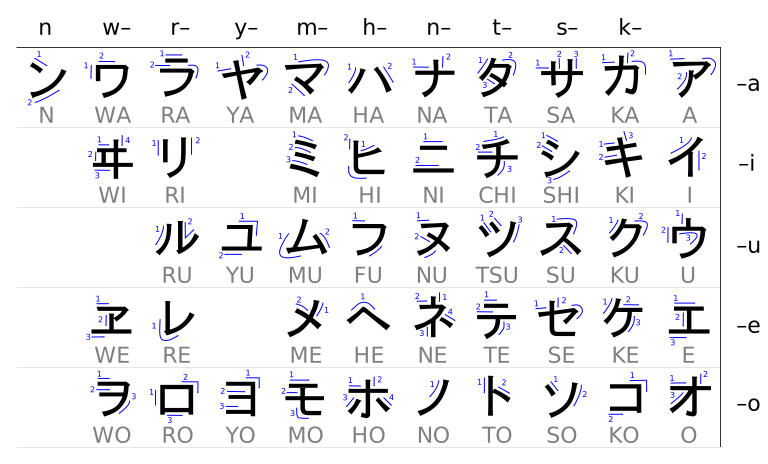
Practice
Now that you understand how kana works, you should make sure that you can recognize all the characters and that you can read them. I have prepared a tool for you to practice kana:
Practice kanaYou can also try to learn to write the characters, though I do not think it is completely necessary at this stage. I find it more important to get to understand and learn how to read it at first - because this gives you more benefits for less work. Nonetheless, being able to write stuff in kana is certainly a good think. So give it a try if you want to.
When you are comfortable recognizing the characters in the tool linked above, you can try to read some Japanese texts written in kana to get even more practice. Also, it is not necessary that you understand these texts, the main goal is to be able to read all the characters.
And when you are comfortable with kana, feel free to continue with the kanji tutorial that follows.
You are not signed in, so nothing in this lesson is saved.
 Lingaku